
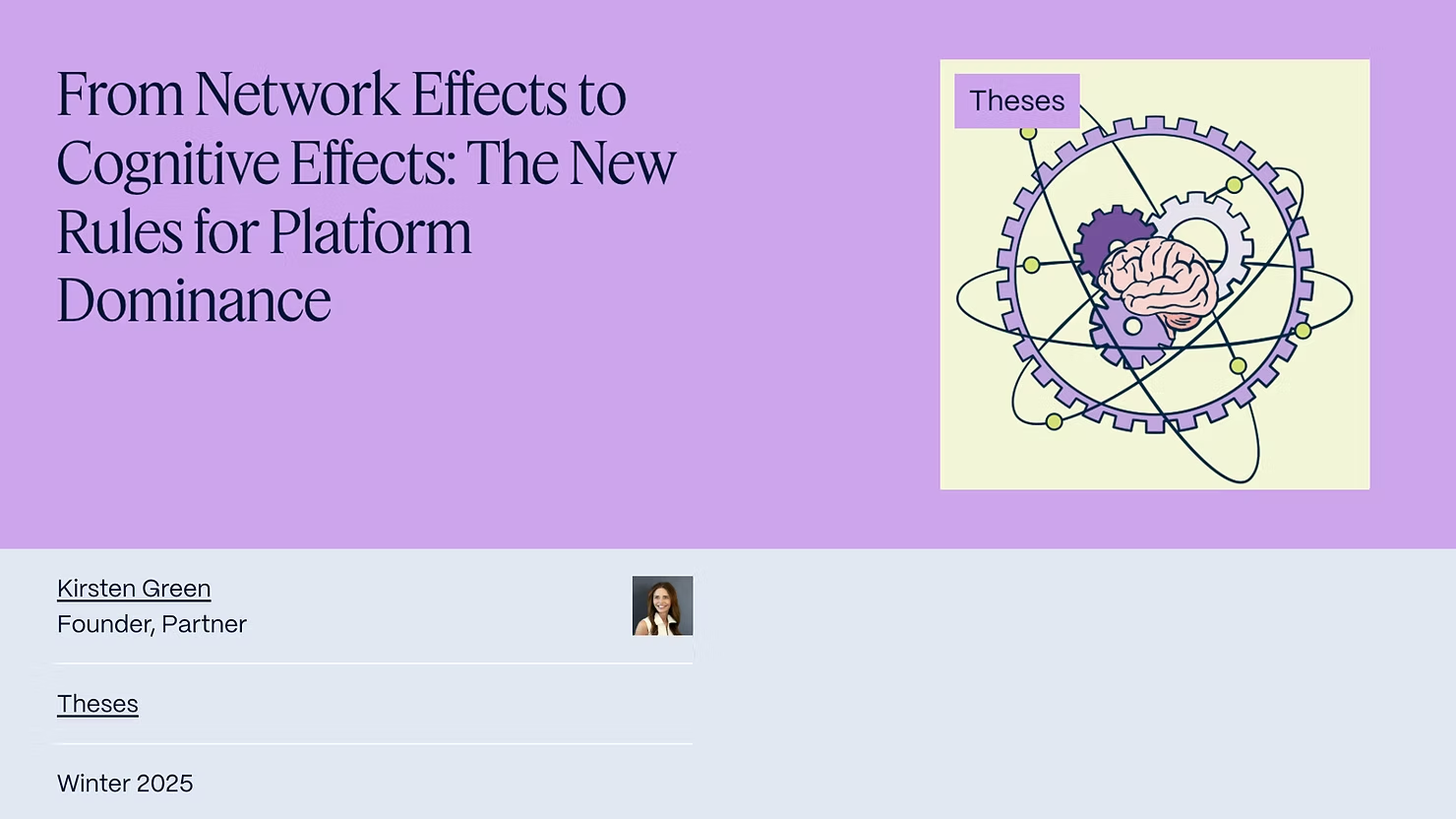
Earlier this Autumn, we published Me, Myself, and My AI: The Rise of AI Companions and we were excited to read Forerunner’s From Network Effects to Cognitive Effects, published last week. The theses might at first look quite different. Ours almost promotes a category, AI companions that act with users, shaping behaviours, decisions, and habits, whilst Forerunner’s harmonises a broader structural shift in how products win. In their view (a view we share!), this requires products to become deeply predictive and personalised.
On reflection, it’s clear that these two ideas are two sides of the same coin: the future of consumer tech isn’t simply undertaking tasks for users, rather it’s understanding them as individuals and earning a form of trust and stickiness that legacy products would struggle to replicate. Clearly, the direction is similar on both sides of the Atlantic.
From tools to partners: the companion thesis
The core argument in our thesis is that AI is moving beyond assistants and tools toward companions: systems that actively engage, motivate, and help change behaviour, often across domains such as health, finance, education, and lifestyle. These companions differ from traditional agents in several key ways:
- They leverage behaviour science and habit frameworks, not just reactive logic.
- They maintain persistent context and memory, letting them provide ongoing guidance, not one-off answers.
- They integrate with personal data like health metrics, financial accounts, and calendars, enabling personalised recommendations and nudges.
- They become partners in transformation
This isn’t just semantics. AI companions aspire to build relationships - emotionally intelligent, adaptive, and deeply contextual. They aim to transform habits, not just execute commands.
Moats beyond network effects
Kirsten Green’s lens for Forerunner frames cognitive effects as the next great source of product defensibility - a successor to network effects and scale. Instead of a value that increases with more users (a classic network effect), cognitive effects accrue per user, based on how much a product understands someone’s unique context and pattern. Products with strong cognitive effects don’t just get hard to leave because of inertia; they become meaningfully woven into how people think and act.
For example, losing access to a music service means losing an understanding of your behaviour, mood, and cues that shaped personalised recommendations, not just access to your playlists! That’s cognition, not just data.
Where the theses converge
At a high level, both theses are wrestling with the same fundamental shift in user expectations:
- Users are ready for products that anticipate needs
- The value exchange is shifting: people are willing to share personal context if it yields genuinely useful, predictive outcomes and privacy/agency is respected.
- The real competitive advantage is understanding the user deeply and over time - rather than aggregating millions of superficial interactions.
In other words: companions embody cognitive effects.
While we zone in on what these companions are and how they might play out across verticals like health, finance, and education, Forerunner articulates the macro-dynamic that makes this approach foundational to how software will win in the 2025–2035 decade. If you’re yet to read them, we suggest reading Forerunner’s first and then ours!
Why this matters for startups now
The world has seen network effects dominate for decades, from social platforms to marketplaces. But a network, whether a social graph or a product ecosystem, is one type of lock-in. Cognitive effects unlock a different one: per-user stickiness built from personalisation, prediction, and trust.
For startups, this shift has practical implications:
1. Think beyond scale - think depth
Traditional early-stage thinking is often: acquire many users, then figure out monetisation. The cognitive era flips that: maximise value per user first. For AI companions, this means optimising for deep understanding and transformation in a narrow domain before chasing broad horizontal adoption.
For example, a habit-forming health coach that can predict flare-ups or customise nutrition advice builds deeper trust than a general wellness app that tries to be all things to all people.
2. Vertical focus wins the early phase
Depth beats breadth early. Forerunner explicitly says vertical mastery beats horizontal expansion in cognitive products. Brighteye’s detailed market map similarly suggests that niche, regulated verticals (like chronic health, personal finance, K12 learning) are where companions can first demonstrate real transformation and defensibility.
Startups building companions should choose a vertical where they can integrate deeply with data sources, evidence-based behaviour science, and regulatory frameworks, making it painful for a horizontal giant to replicate.
3. Personal data as a partner
A key part of cognitive effects is collecting data and using it to predict, contextualise, and anticipate user needs in ways that feel natural and trust enhancing. Startups should focus on architectures and data strategies that prioritise:
- Persistent, privacy-preserving memory
- Transparent consent and user agency
- Intelligent retrieval and inference mechanisms
- Seamless multi-modal integration (calendar, sensors, text history, etc.)
This is what makes a product feel alive rather than mechanistic.
4. Combine AI companionship with cognitive design
If companions are about relationship and cognitive effects are about understanding, then founders should be building products that are relationship engines (rather than assistants).
This means investing in:
- Behaviour science frameworks
- Longitudinal context tracking
- Proactive nudges, not just reactive answers
- Emotional intelligence, empathy cues, and interpretable personalization
The technical challenge is significant, but the reward is a product that feels uniquely aligned to each user, a key step toward cognitive lock-in.
What’s next? Portable cognition OS
Forerunner’s thesis also imagines a future where cognition isn’t siloed, where memory and understanding can travel across apps in a seamless yet privacy-respecting way. The idea of a portable cognition layer, something like Plaid for personal context, is a generational opportunity.
This underscores a possible blueprint for founders building in this space:
- Build vertical companions that earn trust and understand users deeply
- Then think about systems that let that understanding travels with the user across domains
- Create protocols and APIs for personal context exchange that preserve privacy and security
AI companions are an embodiment of a shift in how products create lasting value. As products move from aggregating users (network effects) to understanding individual minds (cognitive effects), the winners will be those who master consistency, trust, and predictive personalisation.
For founders eyeing the next decade, the opportunity is in understanding humans and in returning that understanding in ways that are delightful, respectful, and genuinely human.