

In Plain Sight - 15
In Plain Sight is a weekly blog from Rhys that we will publish every Thursday/Friday. Each edition will be focused on a thorny topic within investing, startups, learning and work and policy.
In Plain Sight is partially a personal attempt to think independently and to avoid leaning too much on AI for answers to our questions. Will we use AI to edit and polish the text? Yes. But more importantly, will we come up with all of the ideas and analysis? Yes.
Here follows Edition 15 - 'Beyond the payroll: why employers are becoming educators'
------
Ask most finance directors why they hesitate to fund an employee's degree and you will hear a version of the same worry: what if we pay for it and they leave?
It is a reasonable question. It is also, in our view, increasingly the wrong one.
Across the US, the UK and Europe, employers are reaching further into the education of their people than at any point in recent memory. They are reaching upstream, before someone is hired, through apprenticeships, degree apprenticeships and industrial placements. And they are reaching downstream, beyond the job itself, by funding degrees and qualifications that have nothing to do with the role, often with no obligation to stay.
The common thread is this: the old model, where you study first and then work, is breaking down, and employers are filling the gap. Their relationship with talent is starting to span a whole career, not just a tenure.
The consulting firms worked this out decades ago
The strategy consultancies have long treated education as a recruitment tool. McKinsey, BCG and Bain commonly sponsor consultants through an MBA, usually in exchange for a return commitment of around two years. The firms don't publish the terms, but estimates put the package at full tuition plus a stipend, repayable if you don't come back.
The more interesting part is what happens when people leave. McKinsey has more than 65,000 alumni, 28 of whom currently run Fortune or Global 500 companies, according to Fortune. The firm runs around 180 alumni events a year, and a senior partner describes alumni as involved in nearly every major client situation.
The lesson is simple. Investing in people who later leave isn't a cost to be minimised. Done well, it is how you build a network, a brand and a client base.
EY took this further in 2020, offering a free corporate MBA with Hult to all of its roughly 284,000 people, earned through skills badges rather than a return commitment.
Reaching downstream: education that isn't tied to the job
What was once an elite perk is spreading to the frontline. A wave of large employers now pay upfront for degrees and credentials that have little to do with the role, and many say explicitly that there is no obligation to stay.

Amazon's programme is the clearest European example too. It runs in nine European countries, including the UK and Germany, and since August 2025 prepays up to 100% of fees, with more than 50,000 European participants since 2014.
The companies make a retention case for all this. Walmart says completers are three times more likely to stay and to be promoted. Target claims 76% lower turnover among participants. The best independent evidence remains Lumina's 2016 study of Cigna, which found a 129% return in avoided talent costs.
Reaching upstream: hiring people before they finish learning
In the UK and Europe the bigger story runs the other way. Employers are moving into the years before someone is fully qualified.
In England, apprenticeship starts rose 8.7% to 308,770 in the first nine months of 2025/26, and higher-level starts grew 13.6%, according to DfE data. The Institute of Student Employers found graduate vacancies fell 8% last year while apprentice hiring rose 8%. There are now just 1.8 graduate hires for every apprentice.
The professional services firms are leading the way:
- PwC's Flying Start degrees combine university study with paid placements, and students finish with 85% of their accountancy exams done.
- Deloitte took on more than 1,500 early-careers starters this September, including graduates, apprentices and placement students.
- BAE Systems, Network Rail, Lloyds, JLR, the BBC and EY all sit in the government's 2026 Top 10 apprenticeship employers.
Germany has done this for generations. The dual-study model (Duales Studium) combines a degree with paid work at a sponsoring company. Dual students have nearly tripled, from 40,982 in 2004 to 113,526 in 2024, according to BIBB. Deutsche Bahn alone took on about 5,200 trainees and dual students this September.
Industrial placements are the exception to this growth. ISE data shows placement hires fell 4% in 2024/25, with 123 applications per place. Demand from students is high; supply from employers is not keeping up.
Why now?
Three pressures are coming together.
The entry-level squeeze. Graduate job adverts are at their lowest for the time of year since 2020, according to Indeed, while a record 9.4% of postings now mention AI. AI is part of the story, but not all of it. In Deloitte's survey of CFOs, cost control (net 64%) ranked ahead of AI (net 47%) as a reason for hiring fewer graduates. Either way, the junior tasks people used to learn on are thinning out. If firms want a pipeline of senior talent in ten years, they increasingly have to build the bottom of the pyramid on purpose.
A front-loaded model that no longer fits. A degree at 21 was never designed to carry a 50-year career, still less one reshaped by AI every few years. Somebody has to pay for learning in the middle of a career. The employer is the party closest to the need, with both the money and the motive.
Policy is nudging employers to act. England's apprenticeship levy is becoming the Growth and Skills Levy, adding foundation apprenticeships and short courses. At the same time, public funding for Level 7 apprenticeships for over-22s ended in January 2026. That pushes employers back towards paying for Master's-level training, such as MBAs, themselves.
If the first rung breaks, start the ladder lower
If the entry-level job no longer reliably turns a graduate into a productive professional, it raises a question: why wait for the graduate at all?
We think the logical next step is that employers identify talent younger, and get involved in careers earlier, well before the campus ambassador or the milk-round stand. Professional football is a useful comparison. Clubs stopped waiting to sign finished players at 18 and built academies that scout at eight. Employers may be heading the same way.
The early signs are already visible:
- Recruitment is starting years ahead. Banks used to open internship applications about a year out. For summer 2027, firms including Lazard, Rothschild and RBC were taking applications in December 2025, mostly from students in their second year, nearly two years in advance.
- Employers are co-designing schools. IBM's P-TECH model, launched in Brooklyn in 2011, lets students earn a high school diploma and an associate degree together, with company mentors, paid internships and first-in-line hiring. It now runs in more than 600 schools across 28 countries.
- Some countries already work this way. In Switzerland, compulsory schooling usually ends at 15, and two-thirds of young people then go into an apprenticeship. The employer is part of a teenager's education from the start.
- Policy is moving the starting line too. England's new foundation apprenticeships target 16 to 21-year-olds, and T Levels include a substantial industry placement with an employer while students are still at college.
The logic follows from everything above. If employers are paying for learning after people leave, and building the first rung themselves, the cheapest place to shape a career is before it starts.
There is a harder side to this, and we'd be wrong to ignore it. Selecting talent at 15 or 16 risks favouring the children whose parents know how the system works. It can close doors on late bloomers. And it hands employers a great deal of influence over what young people learn. The football comparison cuts both ways: academies produce stars, but they also release thousands of teenagers each year with a narrow set of skills. Done well, early involvement widens access. Done badly, it simply moves the gatekeeping earlier.
Train to retain, or train to release?
Most corporate learning has been designed to retain: firm-specific skills, internal academies, and qualifications with clawback clauses. The logic is defensive. Train people to do the job here, and make it costly for them to leave.
A growing share is designed to release: portable degrees and credentials, no strings attached, explicitly useful "with other companies". The logic is that people choose employers who invest in their future, stay longer because they feel invested in, and become ambassadors, clients or boomerang hires when they do leave.
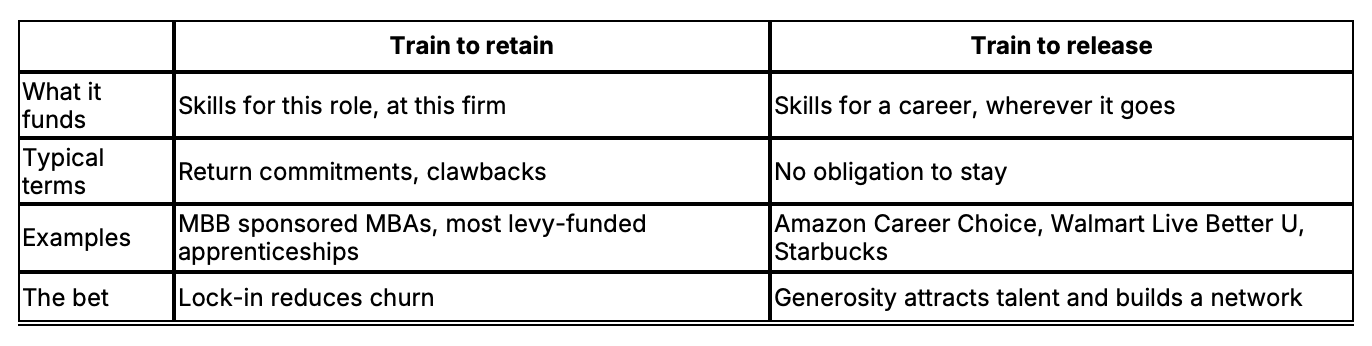
The paradox is that the release model often seems to retain better. That's the McKinsey alumni insight, applied to a warehouse floor or a coffee shop.
So, what could go wrong
- Low take-up. Around 90% of mid-size and large employers offer tuition aid, but fewer than 10% of eligible workers use it in a given year, and often far fewer. A benefit nobody uses is a press release, not a strategy.
- Fragile funding. Corporate generosity follows the cycle. Guild, the platform behind many US programmes, cut a quarter of its workforce in 2024 and some employers have dropped it. Siemens now takes on about 1,500 trainees a year in Germany, down from about 2,100 in 2019.
- Pilots that quietly end. Starbucks offered UK staff ASU degrees in 2019, but as a pilot for 100 people, and we found no sign it continues.
- Narrow menus. Many programmes fund only partner institutions. The employer becomes a sales channel for a handful of providers, and "choice" is curated.
- Who gets left out. Learning tied to an employer leaves gig workers, the self-employed and people between jobs on the outside. In England, apprenticeship starts among under-19s fell 5.4% even as starts among over-25s rose 17.5%. Much of the growth is upskilling existing staff, not opening doors for young people.