

When we look at some of the largest rounds being announced at the moment, we often find ourselves feeling that whilst a lot of the products are incredibly impressive, not all of it feels like it’s rethinking problems and rather is about automating existing processes.
The current wave of innovation, especially in AI, is one of the most technically exciting moments in decades. Everyone can build. Everyone can (learn to) vibe code.
But it does raise a question: are we solving the right layer of problems?
We’ve become very good at working around problems
Somewhere along the way, we got very good at working around things - not fixing them, not removing them, but adapting to them.
You can see this clearly in the current wave of AI products. We’re building agents for HR, customer support, sales, and internal operations - tools designed to navigate the complexity of modern organisations. And what’s more, the more we realise what’s automatable, the more we congregate around those things - I.e. there are more eyeballs on the opportunity and this gives rise to more competition. We gradually discover where AI can save 5% here and 10% there, as opposed to asking ourselves: ‘do we even need this process?’ or ‘could this process be redesigned so that its complexity is reduced by 50-60%?’.
It makes sense in some ways to focus on these 5-10% opportunities. These problems are real, expensive, and measurable. They are well-defined, repeatable, and perfectly suited to automation. Many of these products deliver genuine value today, particularly in some of our favourite cases, which tend to be the overhauling of operating systems in under-innovated industries.
But they also reveal something deeper: much of what we’re building is designed to operate within existing systems, not to question them.
An adjacent example of this was raised by Alastair Campbell in a recent episode of the The Rest is Politics - when discussing rising oil prices and the partial closure of the Strait of Hormuz, he said “this would be a great moment to talk about the importance of renewable energy sources and our domestic energy independence”. Instead, the UK government and others around Europe are creating schemes to support households still relying on oil for their heating and power… Context of course necessitates these policy measures but the point stands.
The pothole
Imagine there’s a pothole on every street.
What do we tend to do?
We build systems to detect it, suspension to overcome it, tools to report it, software to route around it, and agents to file tickets about it. This is an exaggeration but you get the point… Each step is rational and creates value.
But we’re not actually fixing the pothole. We’ve built an ecosystem around the problem, except the thing that removes it.
This pattern shows up everywhere. We wrap complexity, optimise inefficiency, and manage around friction, rather than asking the harder question: why does this problem exist at all?
The agent moment
The rise of AI agents has accelerated this dynamic.
Agents are powerful because they often sit on top of existing systems and make them more navigable. They can operate messy workflows, replicate human actions, and reduce the burden of repetitive work.
In many ways, they are the perfect tool for imperfect systems.
But that’s also the tension. They allow us to upgrade the worker without changing the work.
That’s not inherently a problem. In fact, it’s often a necessary step forward. Many of these tools are already delivering meaningful productivity gains.
But it can create an illusion of progress, where we feel like we’ve solved something when we’ve only made it easier to live with.
The cost of not fixing the system
When we choose to work around problems instead of solving them, we accumulate layers.
Each layer adds complexity, introduces fragility, and becomes harder to remove over time. What begins as a workaround often becomes permanent. Over time, the system becomes more expensive, less legible, and increasingly resistant to change.
Every workaround is a small tax we agree to pay indefinitely. It’s a bit like expanding technical debt to every aspect of how we live and work.
Why this keeps happening and why this moment matters
There are good reasons we gravitate towards these opportunities.
Working around problems is faster to build, easier to demonstrate, and simpler to sell. It fits neatly into existing systems and produces clear, near-term ROI.
Fixing the underlying problem is different. It requires rethinking systems from first principles, challenging assumptions, and often coordinating across multiple stakeholders. It is harder to demo.
It is simply easier to automate a bad system than to redesign it. So we build where the light is shining.
AI gives us leverage not only to execute faster, but to collapse workflows, remove steps, and redesign systems entirely. Used this way, it becomes more than an efficiency layer. It becomes a system-level tool.
Which raises a bigger question: if we have this capability, where should we be applying it?
The problems that actually matter
If we zoom out, the world is not short of meaningful problems. We are surrounded by them.
Climate systems are under strain and our roll-out of clean energy solutions is too slow. Ageing populations and declining birth rates are a ticking time-bomb for our tax bases and public services. Access to quality education and training remains uneven. Infrastructure and housing is built too slowly. Healthcare and social care systems are stretched and inefficient. Unemployment among young people is rising. Questions of safety, trust, and community stability persist in many places.
These are not problems that lack attention because they are unimportant. They are problems that are hard to solve, structurally, politically, and operationally. They require coordination, patience, and a willingness to engage with complexity.
But they are also the kinds of problems where solving the root cause matters far more than optimising the surface and where redesigning the system creates exponentially more value than incrementally improving it. Individual companies don’t solve these huge issues alone, but they contribute to solving them.
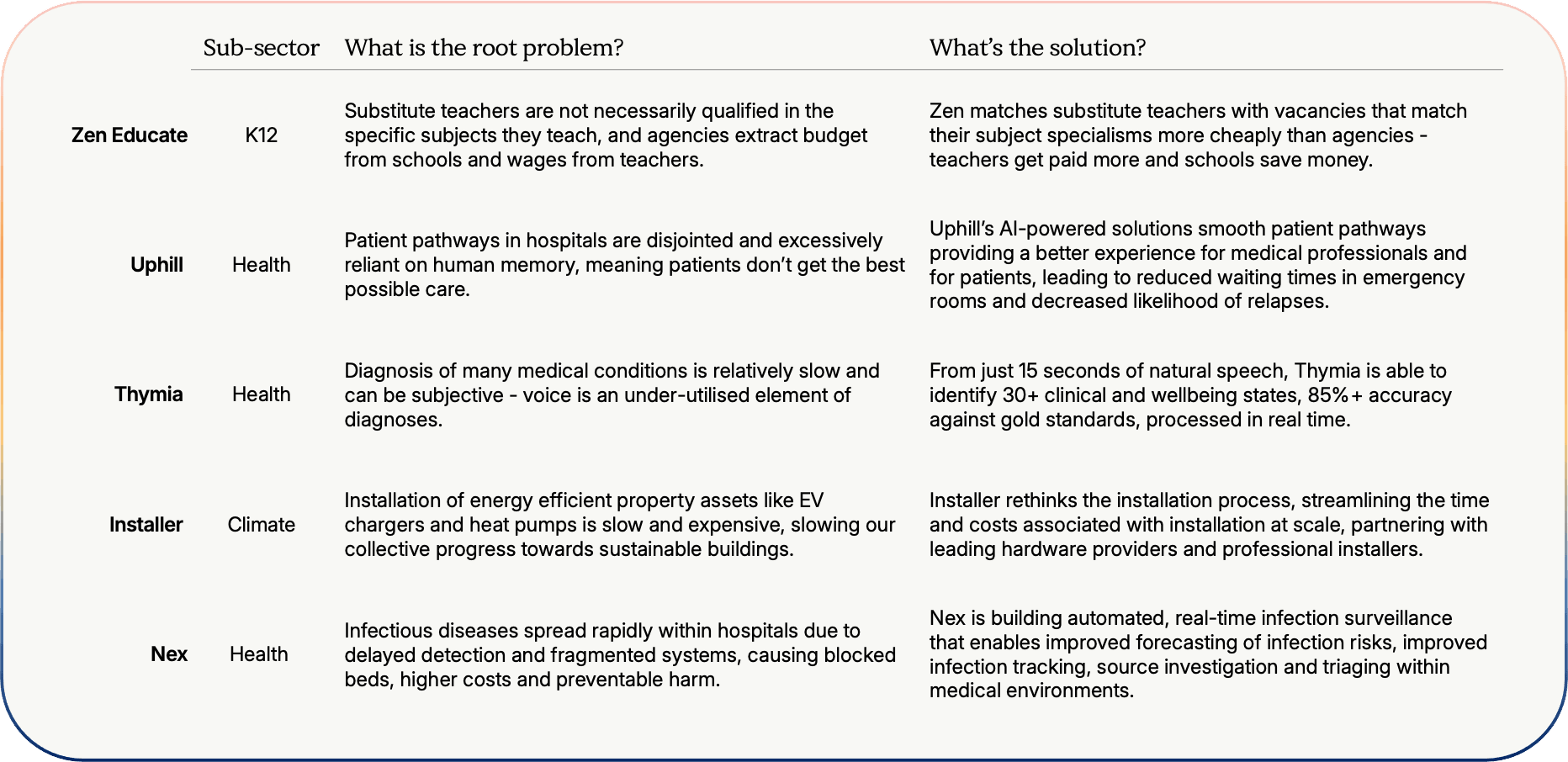
We are proud to back a number of companies that take this approach to solving problems in their sub-sectors:
Two Paths
So, when we are looking at stuff to build, we should consider that for almost every frustrating system, there are two paths:
- Make it easier to live with
- Make it disappear
The first is faster, safer, and more incremental. The second is harder, riskier, and far more transformative.
Most companies, understandably, pursue the first but enduring companies often pursue the second.
With this in mind, there is a simple question worth asking when building anything: am I helping people navigate this problem, or removing it altogether? Both have value but they are not the same.
Fix the road
The most impactful products tend to share a common trait: they don’t just improve workflows, they eliminate them.
The best support experience is not needing support. The best process is the one that doesn’t exist. The best system is the one that doesn’t create the problem in the first place.
We don’t need fewer people building. If anything, we need more ambition - more people willing to question the systems, take on harder problems, and resist the pull of incrementalism when it matters.
Because the real opportunity is in fixing the road, not in helping us drive around the pothole.