



Listen on Spotify, Apple Podcasts, or watch on Youtube.

Timestamps
1:00 What does it actually take to raise in 2026?
2:07 AI lowered the cost of building but raised the cost of differentiation
9:30 Round preemption: how VCs are moving earlier and more aggressively
12:09 Conviction-led vs. momentum-led investors and why founders should know the difference
14:27 The fundraising proof framework: Insight → Pull → Repeatability
14:55 Pre-seed: "Can you see something others don't?"
16:17 Series A in 2026: why it feels like Mission Impossible (and one company doing it anyway)
17:24 Why the gap between pre-seed and seed has widened significantly
25:25 Are you ready to raise? A simple decision tree for founders
26:29 Three questions every founder must ask: AI defensibility, distribution advantage, and does your product get better with every use?
---
We’ve been thinking a lot about a question founders ask us regularly: what is the bar for raising today?
There isn’t one universal answer because it depends on your stage, business model, trajectory and, whether we like it or not, how much investor appetite there is for the space you are building in.
That said, something has clearly changed since late 2024.
AI has made it dramatically easier and cheaper to build a good product. Small teams can now ship in weeks what might previously have taken much larger teams months or years. At the same time, we’re seeing companies reach levels of traction at a speed we simply hadn’t seen before (e.g. Lovable, Handshake AI, Mercor, Cursor, etc.).
That creates a paradox: AI has lowered the cost of building, but it hasn’t lowered the cost of differentiation. If anything, it has increased it!
When everyone can build faster and the ceiling of what is possible moves higher, investors naturally become more selective about what truly stands out. So what does the fundraising bar actually look like today?
Each round requires a different type of proof
There are plenty of exceptions, but I find this mental model useful:
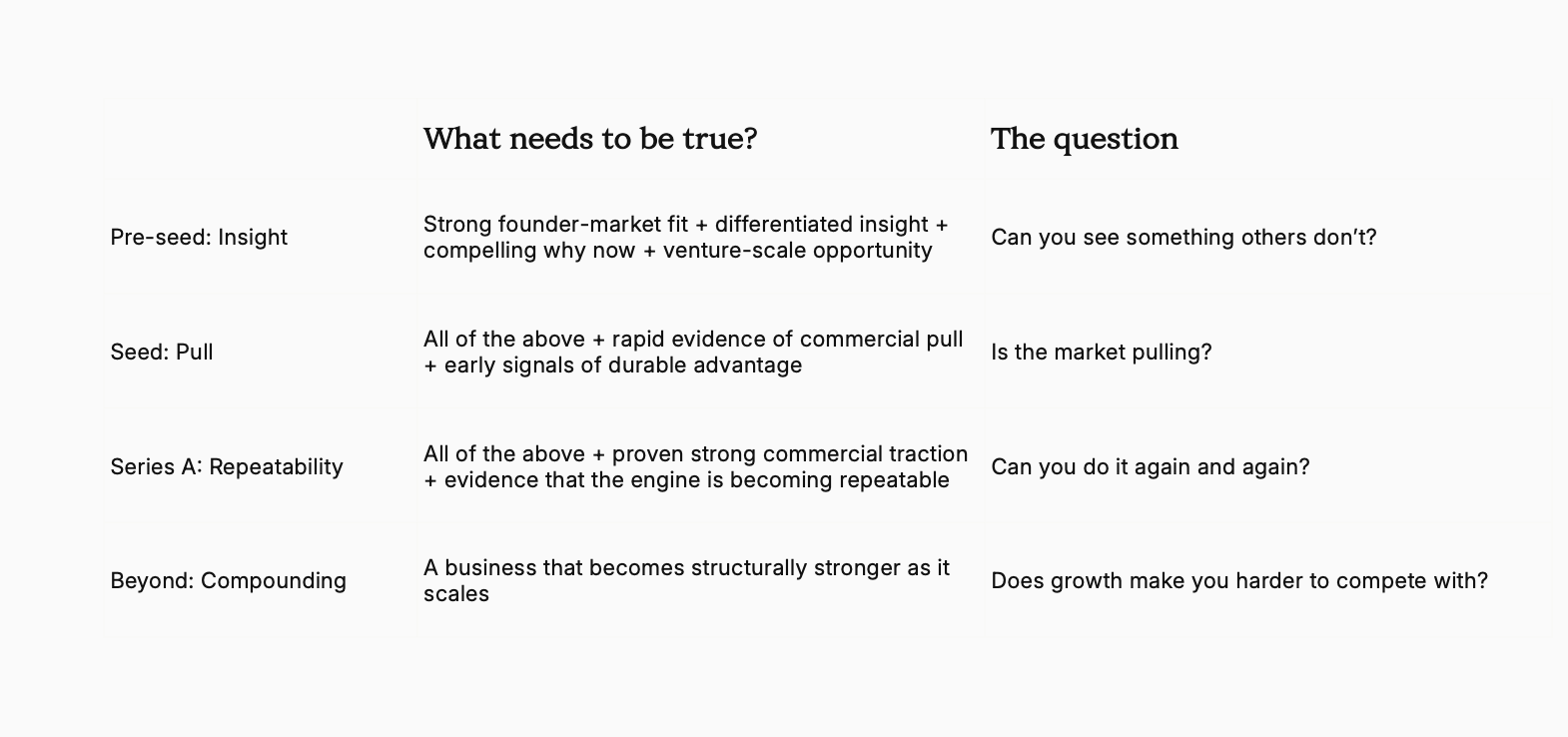
The important point is that the bar is cumulative.
At pre-seed, investors are largely underwriting the founders and their insight. At Seed, they need evidence that the market agrees. By Series A, they increasingly need evidence that what is working can become repeatable. Ultimately, the best companies go one step further: doing it repeatedly makes them stronger.
The numbers vary enormously by business model and market, but getting towards €1m of ARR/revenue unusually quickly and growing ~20% month-on-month can represent exceptional seed-stage momentum. By Series A, €3-6m ARR and >4x year-on-year growth would represent a very strong trajectory in many software categories.
Fundraising markets are not perfectly rational. A hot category can reduce the proof required; exceptional traction can overcome a cold one. If you have runway and another six months would materially improve your position, waiting may be the better decision.
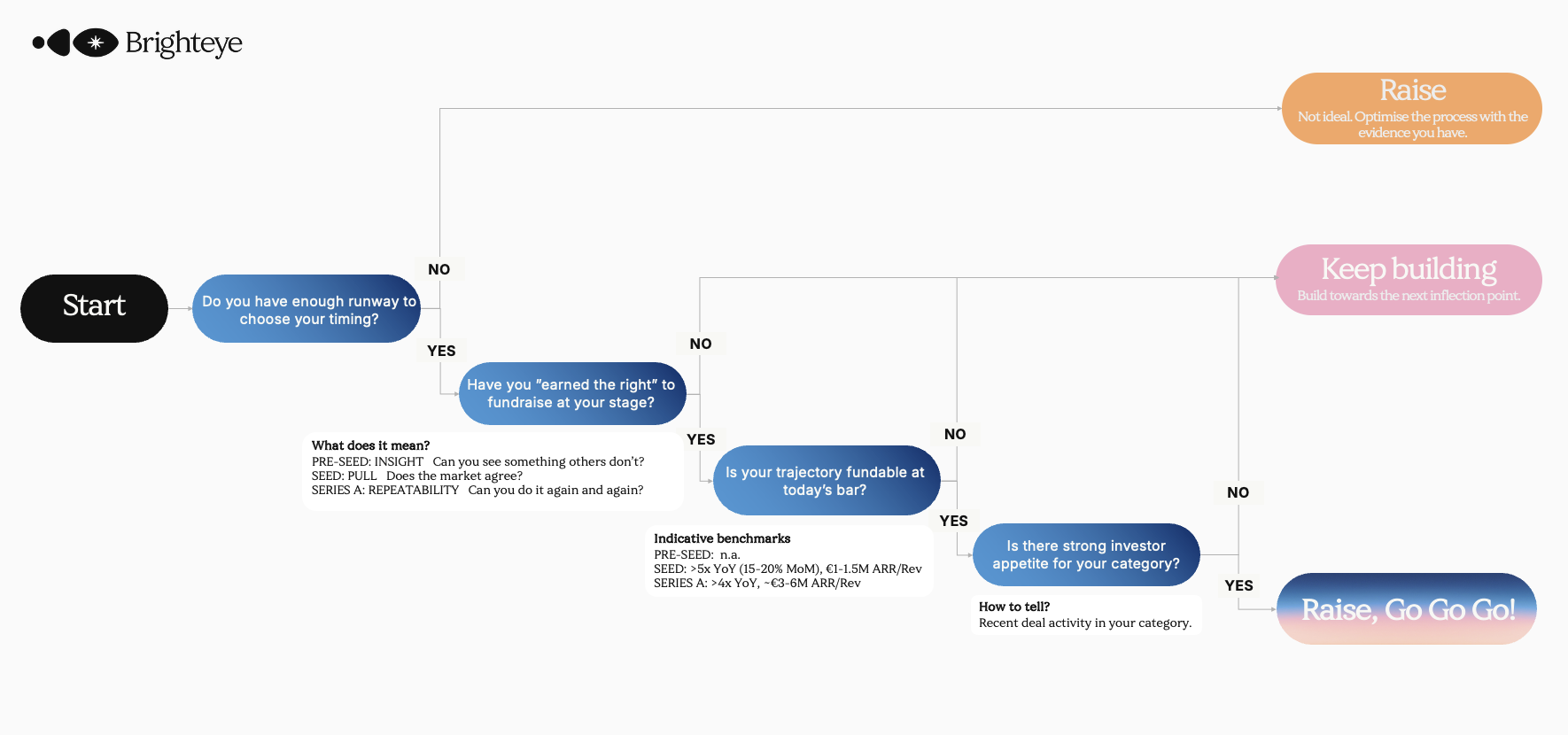
But should you actually raise in this market?
Knowing the bar and knowing when to fundraise are two different things.
If you have enough runway to choose your timing, the question isn’t simply “could we raise?” but “are we entering the market from a position of strength?”
We’d think about three variables: traction, trajectory and market appetite.
Do you have clear evidence that something is working? Is the trajectory genuinely strong? And how much investor appetite is there for the market you are building in?
That last factor matters more than founders sometimes want it to. Keep in mind that fundraising markets aren’t perfectly rational or evenly distributed. Certain categories attract disproportionate attention and capital. In a hot market, companies can sometimes raise with less proof while in an overlooked or poorly understood market, the bar can be considerably higher.
That doesn’t mean chasing whatever is fashionable. It means understanding the market you are fundraising into so that you can prepare. I would argue that very strong traction can overcome a cold category. A hot category can reduce the amount of proof investors require. The bar is relative, not absolute.
And if another six months of execution could materially improve your traction or trajectory, and you have the runway, waiting may put you in a much stronger position.
Getting funded is only the first bar
There is a second question that matters even more: why could this become an exceptional and durable company?
That question is becoming harder to answer because good products are becoming easier to build. As the cost of building falls, the value shifts towards what cannot easily be replicated. For founders building in Learning & Work, we see several shifts pointing to where that advantage may come from:
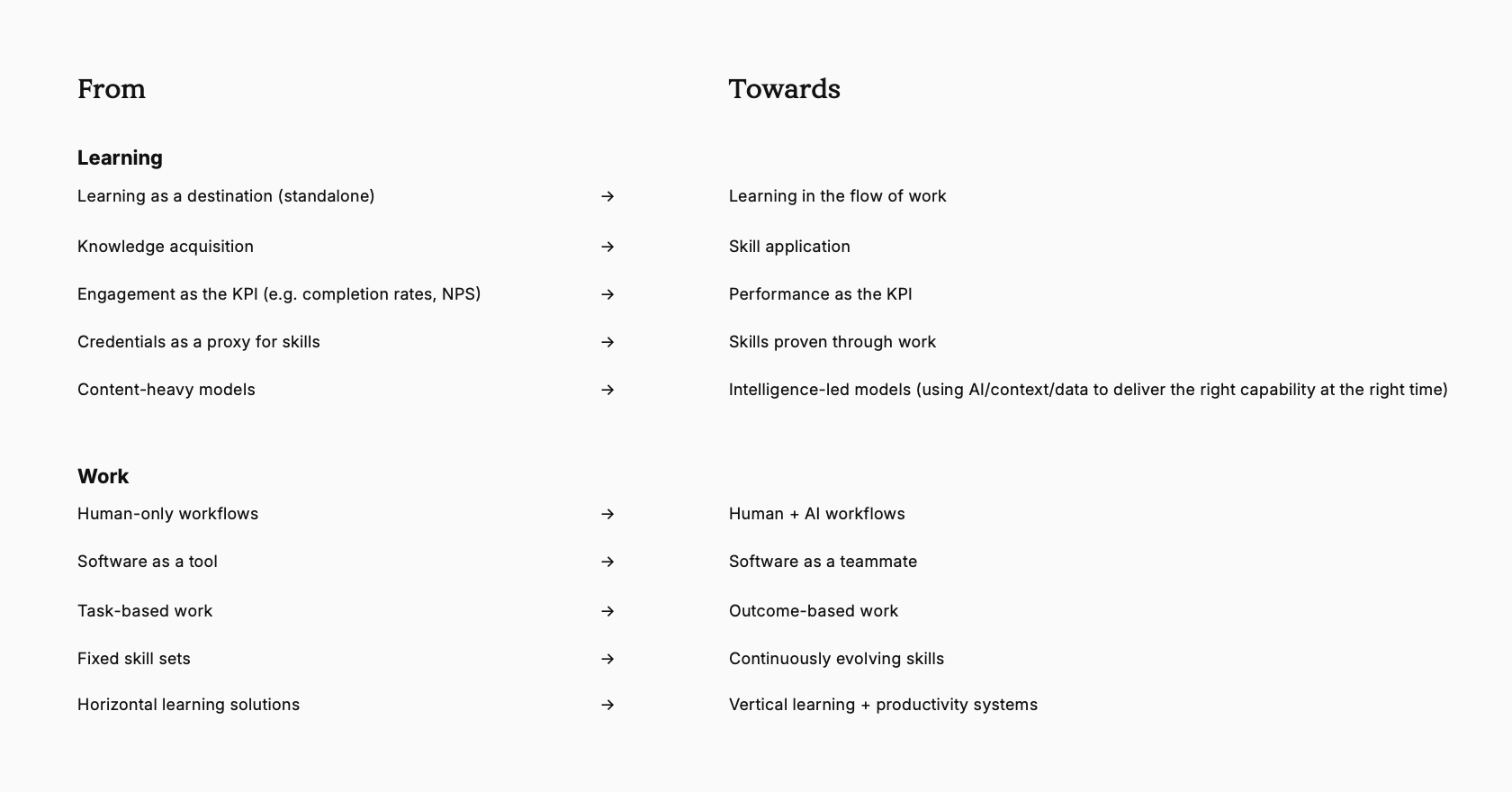
These aren’t simply product trends but instead they point towards where durable differentiation may increasingly come from. The common thread is simple: moving closer to the work might create new sources of defensibility.
A learning solution embedded deeply in a professional workflow is harder to replace than a standalone tool. A product that understands the language, regulation and edge cases of a profession has an advantage over a generic interface. A product whose usage creates better outcomes can become stronger with every customer.
Which leads to perhaps the most important question:
What compounds as you grow?
Hamilton Helmer’s 7 Powers remain one of the best frameworks for thinking about durable competitive advantage: Scale Economies, Network Economies, Counter-Positioning, Switching Costs, Branding, Cornered Resource and Process Power.
AI hasn’t made these irrelevant. If anything, they may matter more as access to the underlying technology becomes increasingly democratised. But I’ve been wondering whether another form of Power is becoming particularly important in the AI era: Learning! Not learning in the education sense but learning as a company’s ability to get better at delivering an outcome with every interaction.
An AI sales coach can learn which interventions actually improve conversion. A recruiting platform can learn which signals predict a successful hire. A product for technicians can learn from every diagnosis and repair. The loop becomes: More usage → more learning → better outcomes → more usage → more learning → etc.
The Power isn’t simply owning more data - lots of companies have data. It comes from turning usage into learning, and learning into better outcomes.
I’m not sure yet whether Learning is genuinely an eighth Power or whether it ultimately sits within Helmer’s existing framework, perhaps somewhere between Process Power and Network Economies? But the distinction matters less than the question it creates for founders: what does your company know after one million interactions that a competitor starting tomorrow doesn’t?
Three key questions before you fundraise
If I were a founder thinking about raising today, I’d therefore ask myself three things:
- If AI gets 10x better tomorrow, does my company become stronger or less necessary?
- Have we earned the right to raise at this stage?
- Do we have a unique distribution advantage?
AI is making it easier to build a company and harder to build one that truly stands out. At exactly the same time, it is opening problems that were previously too complex, too manual or simply uneconomic for startups to tackle. The bar is higher because the opportunity is bigger. Exciting times!
If you want chat more and/or share feedback, please reach out to: dg@brighteyevc.com


.jpg)
