
Five markets, one pattern: where Learning & Work is being rebuilt
Introducing Brighteye's Future of Work Report, Q4 2026
Download the report
Most conversations about AI and work start in the same place: which jobs will disappear? It is a fair question and in places the answer is already visible in headcount data. But on its own, it may be the narrowest question we could ask.
In our new Future of Work Report, the team look at five markets where Learning & Work is being rebuilt: complex supply chains, defence, space, government, and solo work and entrepreneurship. They look like they have little in common. A freight-broker, a defence technician, a satellite operator, a caseworker and a freelance AI evaluator don't immediately have much in common.
But we can assure there are some shared patterns, which we explore in this article and in the full report: expertise is scarce and the tools with which people learn and work have not caught up.
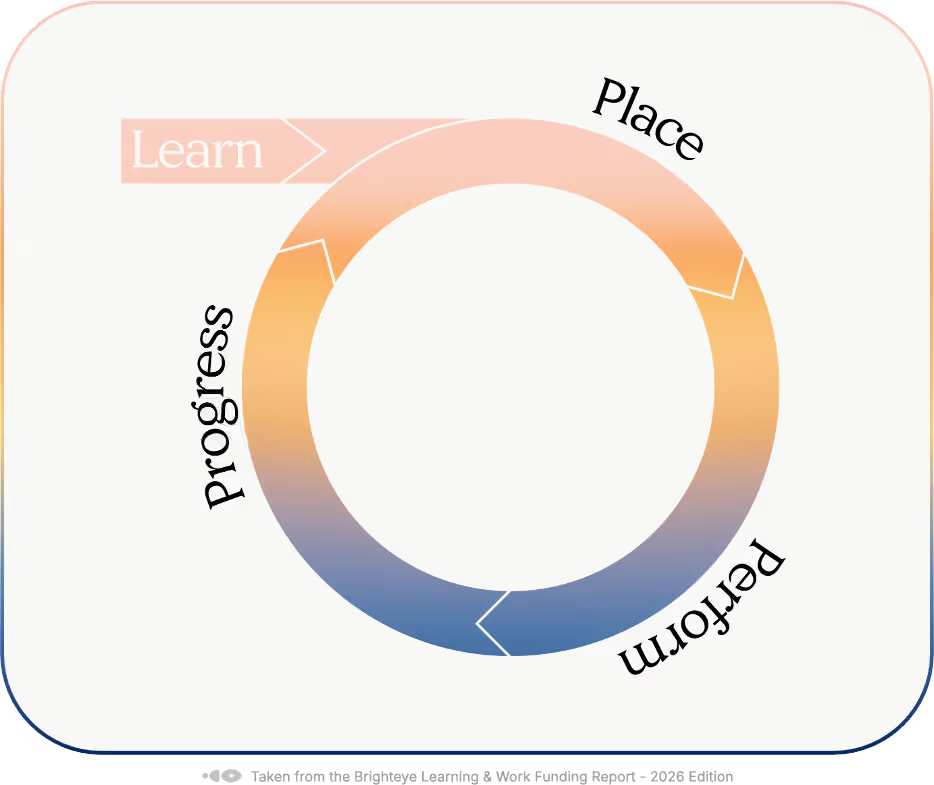
For each market, we mapped against our value chain of Learning & Work (how people Learn, get Placed, Perform and Progress). Again and again, the break was there not being enough people who can make good decisions when the system is under stress.
As per the Brighteye style, each section includes a market map for you to peruse - none aim to be exhaustive.
1. Supply chains: the middle office is being agentified
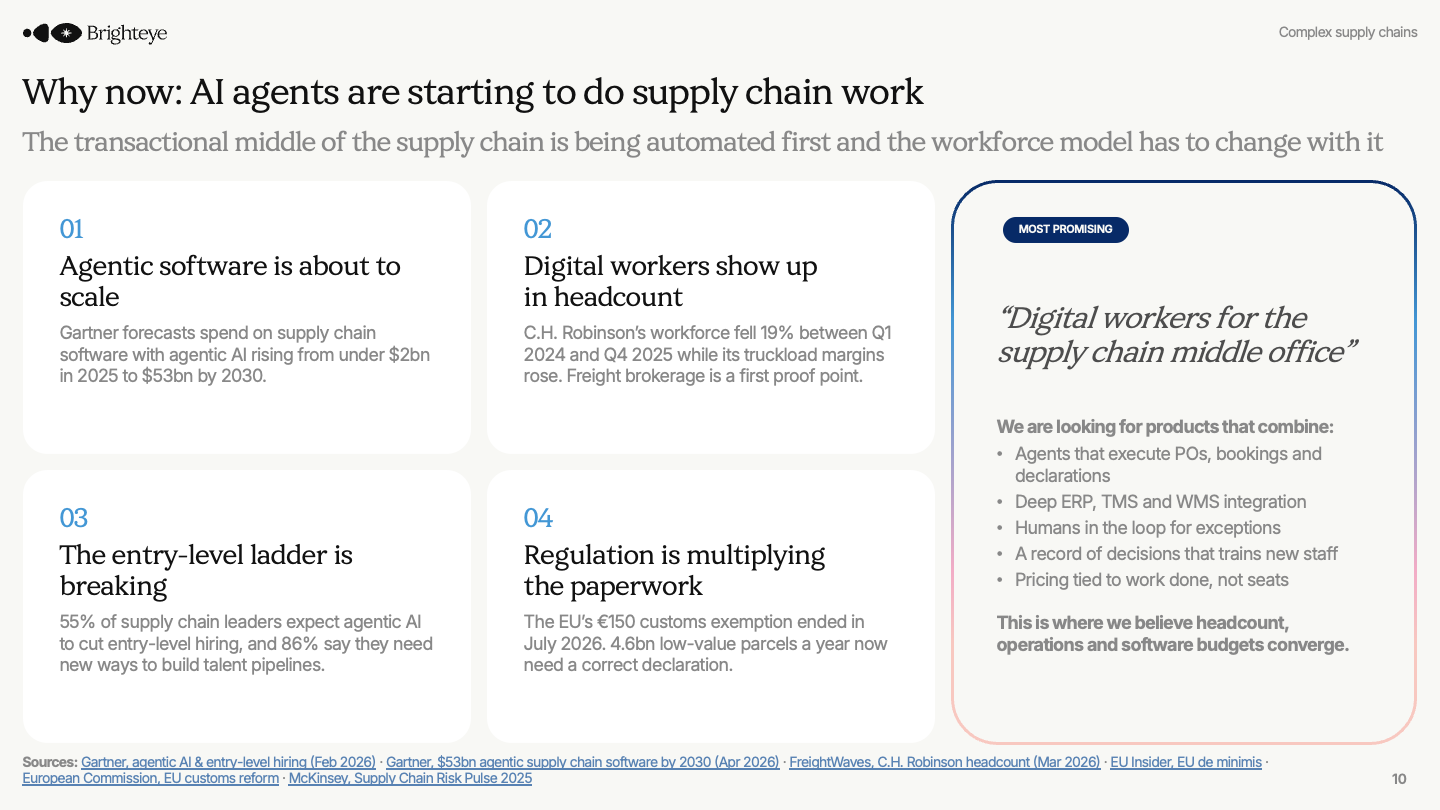
Disruption is now the operating environment. Pandemics, geopolitical fragmentation, climate shocks and trade realignment have pushed firms from just-in-time to predictive. The transactional middle of the supply chain is being automated first.
Gartner forecasts spend on supply chain software with agentic AI rising from under $2bn in 2025 to $53bn by 2030. C.H. Robinson’s workforce fell 19% between Q1 2024 and Q4 2025 while its truckload margins rose, and 55% of supply chain leaders expect agentic AI to cut entry-level hiring.
2. Defence: a rebuilding effort with no one to do the building
Europe has the money. Ukraine, NATO’s new 5% of GDP target and the retreat of US security guarantees have made defence a lasting political priority, and EU-27 defence spending rose 19% in 2024 to a record €343bn.
What it does not have is the people. The European defence industry is short of an estimated 150,000–200,000 skilled workers. A quarter of its engineers and technicians are at or near retirement, with attrition at 13%, four times the US rate. The EU aims to reskill 600,000 people for defence by 2030, but its Skills Academy is not expected before 2028.
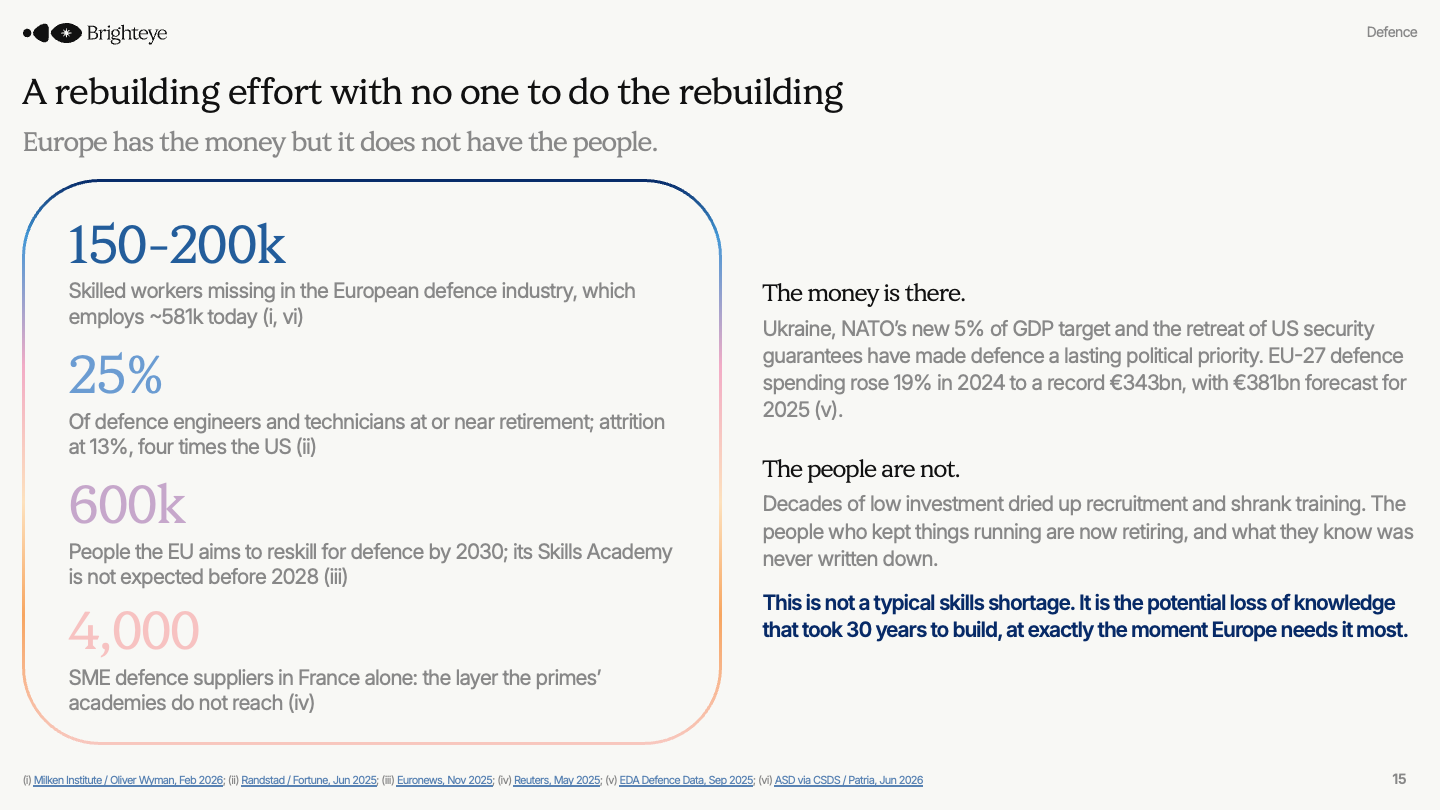
This represents the potential loss of knowledge that took 30 years to build, at exactly the moment Europe needs it most. Much of it sits with retiring technicians, in paper manuals and verbal handovers.
The primes have academies and learning platforms. The gap is the layer below them: some 4,000 SME defence suppliers in France alone, most with no digital training tools, and suppliers like Czech engine maker PBS could double their workforce if they could find the staff. Because the junior–senior gap is a knowledge gap rather than a capability gap, knowledge delivered at the point of work closes it fastest.
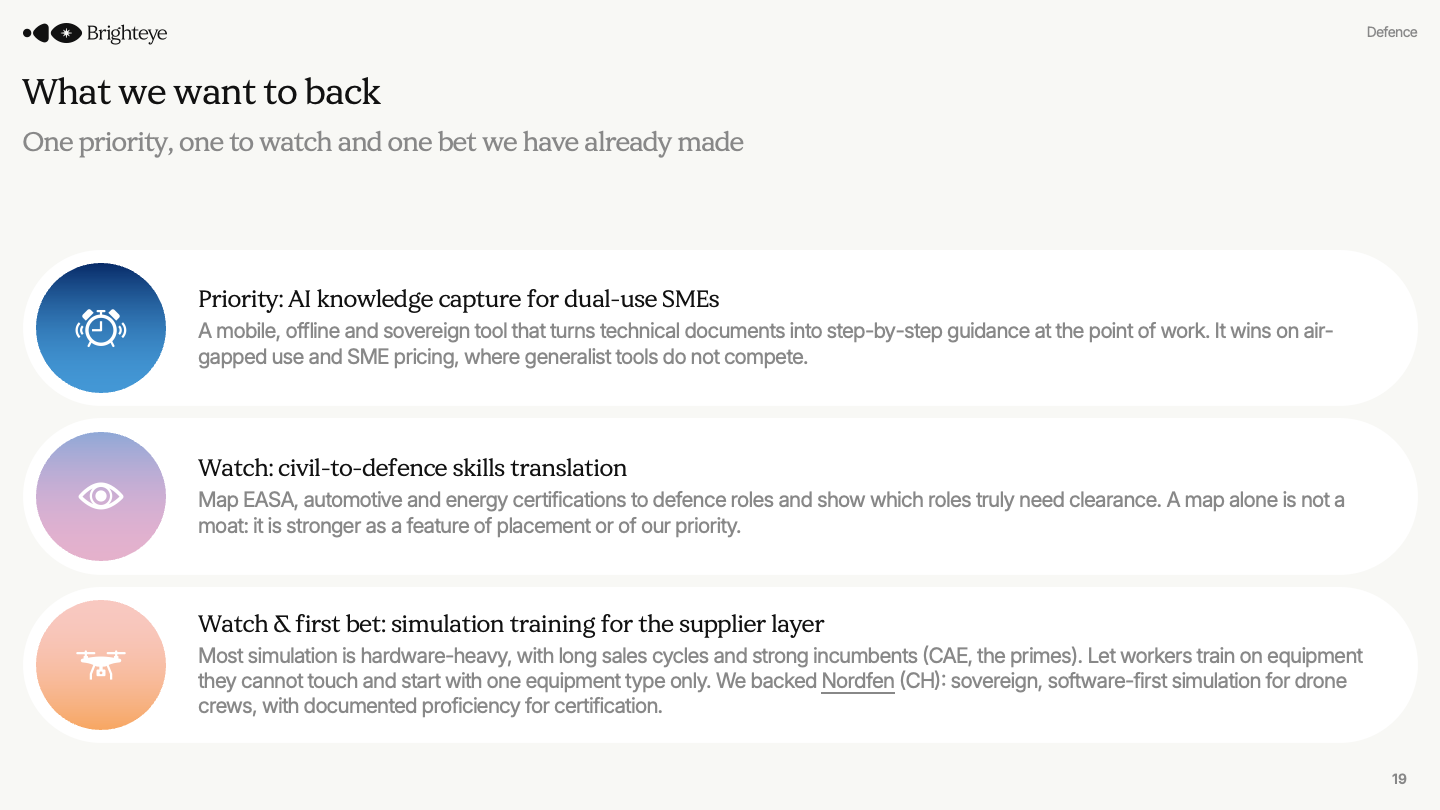
Our priority here is AI knowledge capture for dual-use SMEs: mobile, offline and sovereign tools that turn technical documents into step-by-step guidance on the shop floor. We have already made one bet in the space, backing Nordfen, which builds sovereign, software-first simulation training for drone crews. To be clear about where we stand: we back workforce infrastructure, not weapons.
3. Space: you cannot learn on the job
The space economy was worth a record $613bn in 2024 and is projected to reach around $1.8tn by 2035. But the talent pipeline was built for agencies, rather than for what space is becoming: an industry. Space work is too expensive, hazardous or irreversible to learn by doing, which is why simulation, research and digital twins are set to become core operational infrastructure.

4. Government: the largest buyer founders avoid
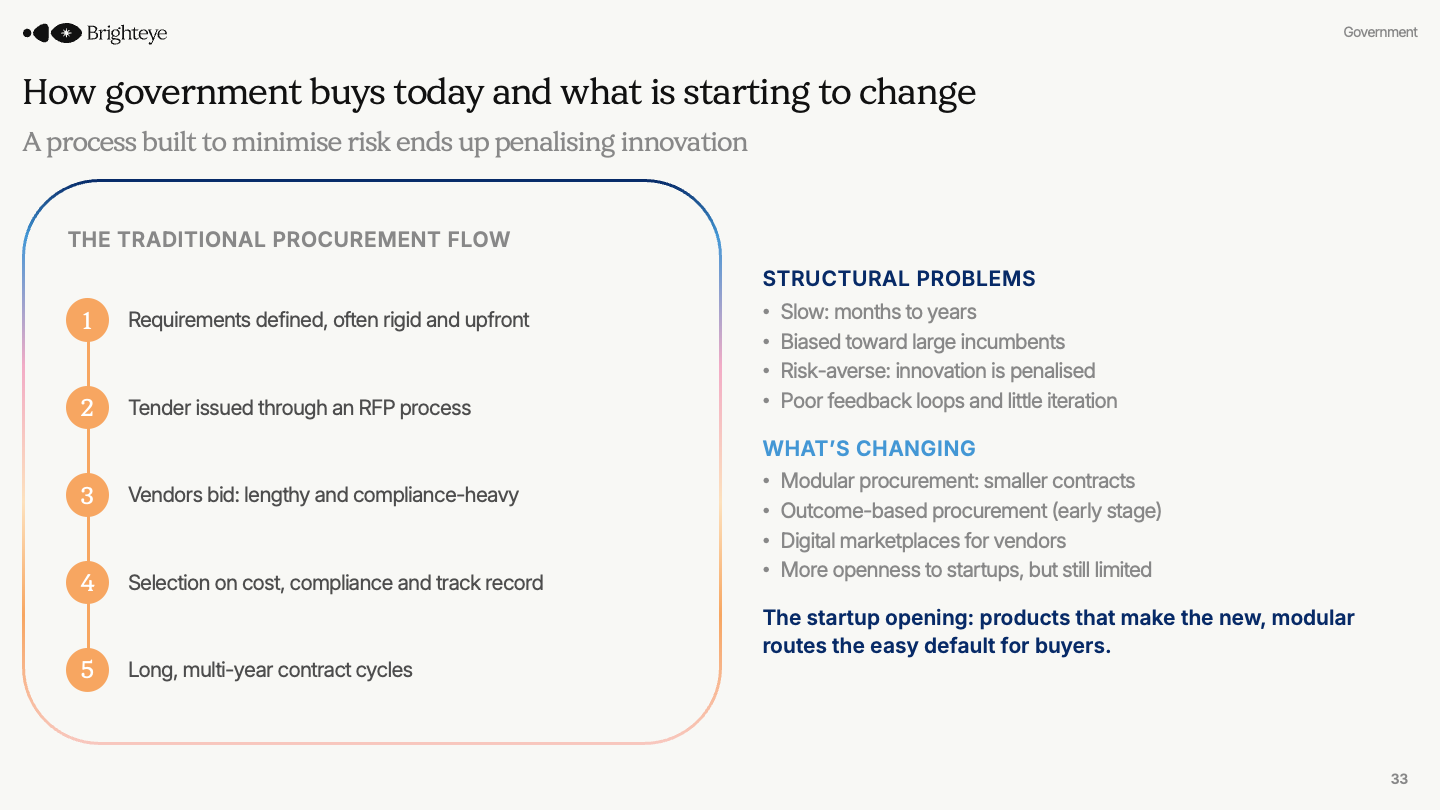
Governments spend roughly $21tn a year on core services, with 12–14% of GDP flowing through public procurement in many economies. Yet many founders steer clear, and for understandable reasons: a buying process built to minimise risk ends up penalising innovation. What is changing is that procurement is becoming a policy instrument, with smaller modular contracts, early outcome-based buying and more openness to startups.
5. Solo work: the solo era (and smaller teams more generally) is here
Two forces are at work. The push: entry-level roles are the easiest to automate, and US graduate underemployment is running at around 42%. The pull: a full solo-preneur tool stack now costs a few thousand dollars a year, and more than a third of new US startups now have a solo founder.
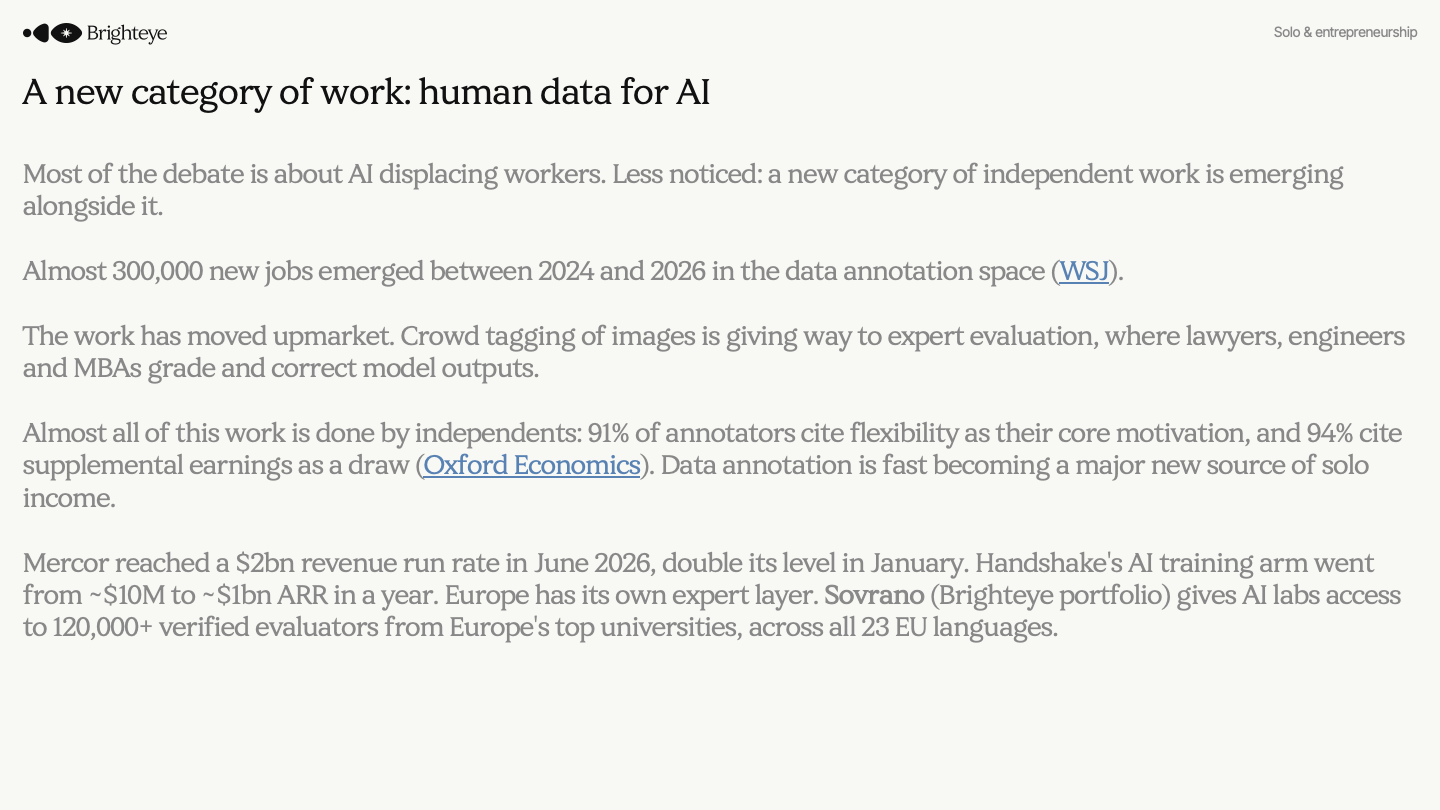
Less noticed is a new category of independent work emerging alongside AI itself: human data. Mercor reached a $2bn revenue run rate in June 2026, and Handshake’s AI training arm went from around $10m to around $1bn ARR in a year. Europe has its own expert layer too. Sovrano, a Brighteye portfolio company, gives AI labs access to more than 120,000 verified evaluators from Europe’s top universities across all 23 EU languages.
Execution vs orchestration
If there is one framing to take away with you after reading, it is this... Across all five markets, work is splitting into two kinds: execution, which is increasingly handled by agents, automation and software; and orchestration, which is judgement under stress, managing exceptions, and coordinating people, data and decisions across handoffs.
The second kind is where value concentrates. It is also the hardest to train for, because classroom and LMS training cannot keep pace. That is why we think the winners will deliver guidance, simulation and captured expertise at the point of work, rather than before it.
-----
What could go wrong
We do not want to oversell this. The risks are real.
As we have discussed in recent blogs, automating junior work could hollow out the very ladder that produces experts, faster than anyone builds a replacement. Government and defence sales cycles still run to months or years, SME suppliers have low digital readiness, and defence priorities could shift after a ceasefire. Space remains concentrated around a small number of large buyers. And human data work is still project-based and volatile: a fast-growing income source today is not yet a stable career.
None of these breaks the thesis, but each shapes where we would build. We believe the opportunity sits with products that make the new routes the easy default, rather than products that assume the old institutions will move on their own.
Where we want to invest
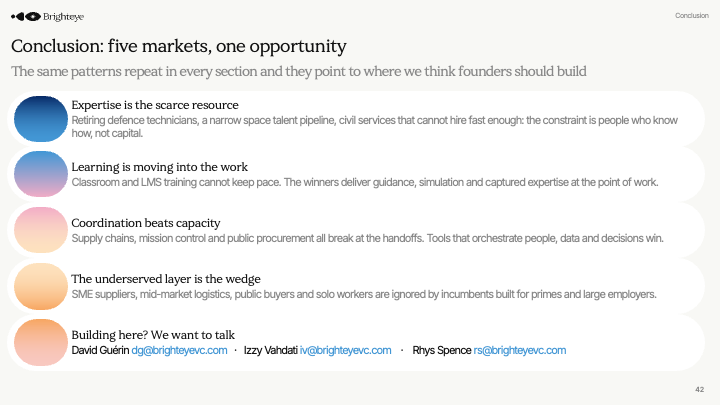
We consider the under-served layer to be initiali wedge: SME suppliers, mid-market logistics, public buyers and solo-workers, all ignored by incumbents built for primes and large employers. Each section of the report closes with the specific theses we are excited about, from "digital workers for the supply chain middle office" to"mission readiness systems" and "procurement-to-capability"platforms.
Download the report
If you are building in any of these spaces, we would love to talk to you.
Get in touch with:
David Guérin / dg@brighteyevc.com
Izzy Vahdati / iv@brighteyevc.com
Rhys Spence / rs@brighteyevc.com