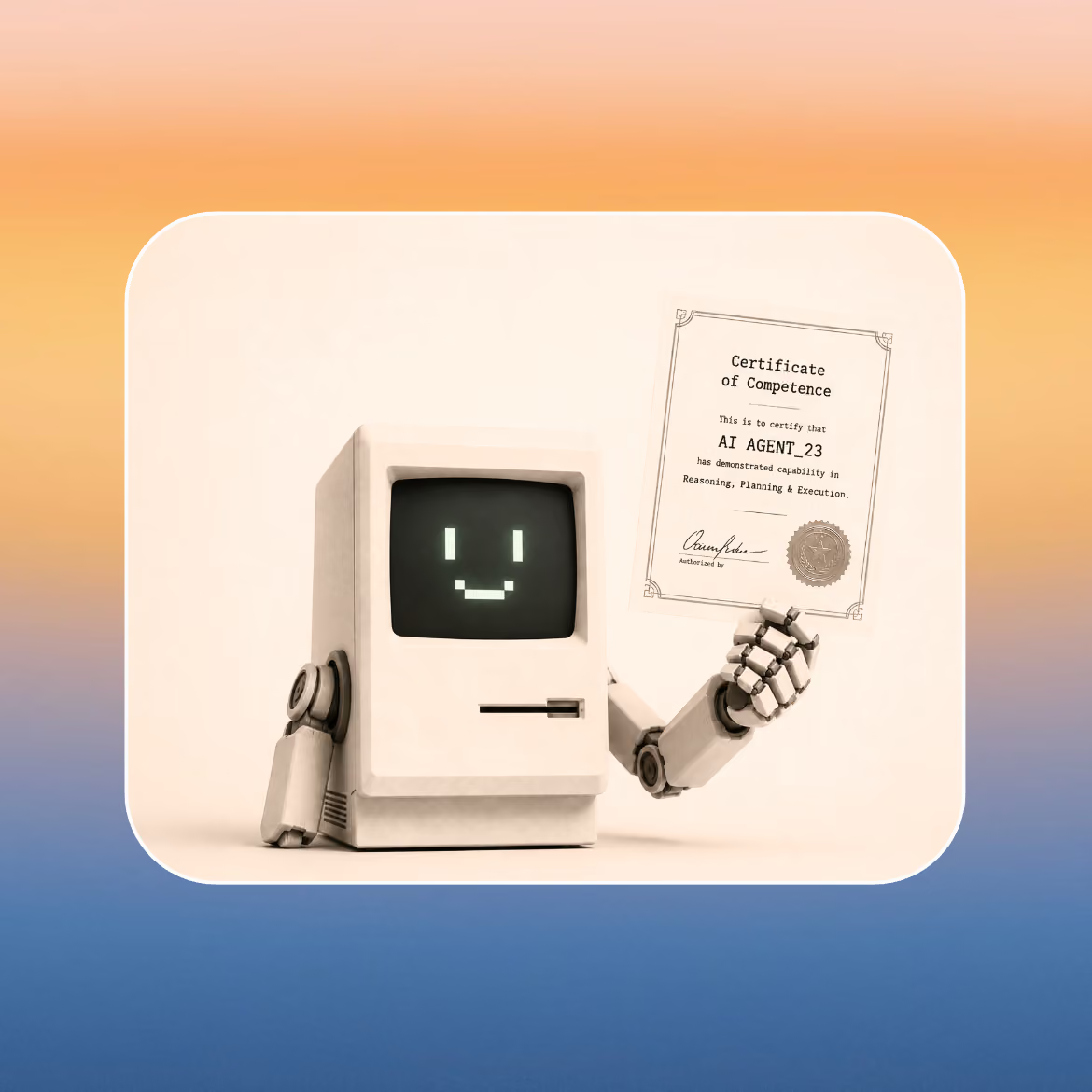
AI agents are quickly becoming a new type of worker, or at least a new type of co-worker.
Today they can analyse financial statements, prepare tax filings, review contracts, assess students, coach people, give feedback in real time and perform many other tasks that were traditionally done by trained professionals. The technology is improving so quickly that it is becoming increasingly difficult to distinguish between a tool that supports a professional and an agent that effectively performs the job itself.
The problem is that we currently have no simple way to know whether these agents are actually qualified to do the work they claim to do.
For the past hundred years, we have relied on certifications and professional qualifications to create trust. Accountants become chartered before signing off company accounts, financial analysts obtain recognised qualifications before advising clients, industrial electricians must hold electrical qualifications and additional authorisations to work on live electrical systems, doctors complete years of medical training and obtain a licence before treating patients, teachers are trained and certified before entering a classroom. These systems do not guarantee perfection, but they give us confidence that a minimum standard has been met and that someone is accountable if things go wrong.
AI agents have no equivalent today.
Any company can launch an AI financial analyst, an AI tax advisor, an AI teacher or an AI coach, yet there is often no independent verification that the agent can perform the role reliably, safely and in line with industry standards. In most cases, users are simply asked to trust the vendor's claims.
We believe this will become increasingly difficult to accept as agents take on more responsibility and begin operating in regulated and high-trust environments. This is why we think a new category will emerge around certification infrastructure for AI agents.
What could this look like?
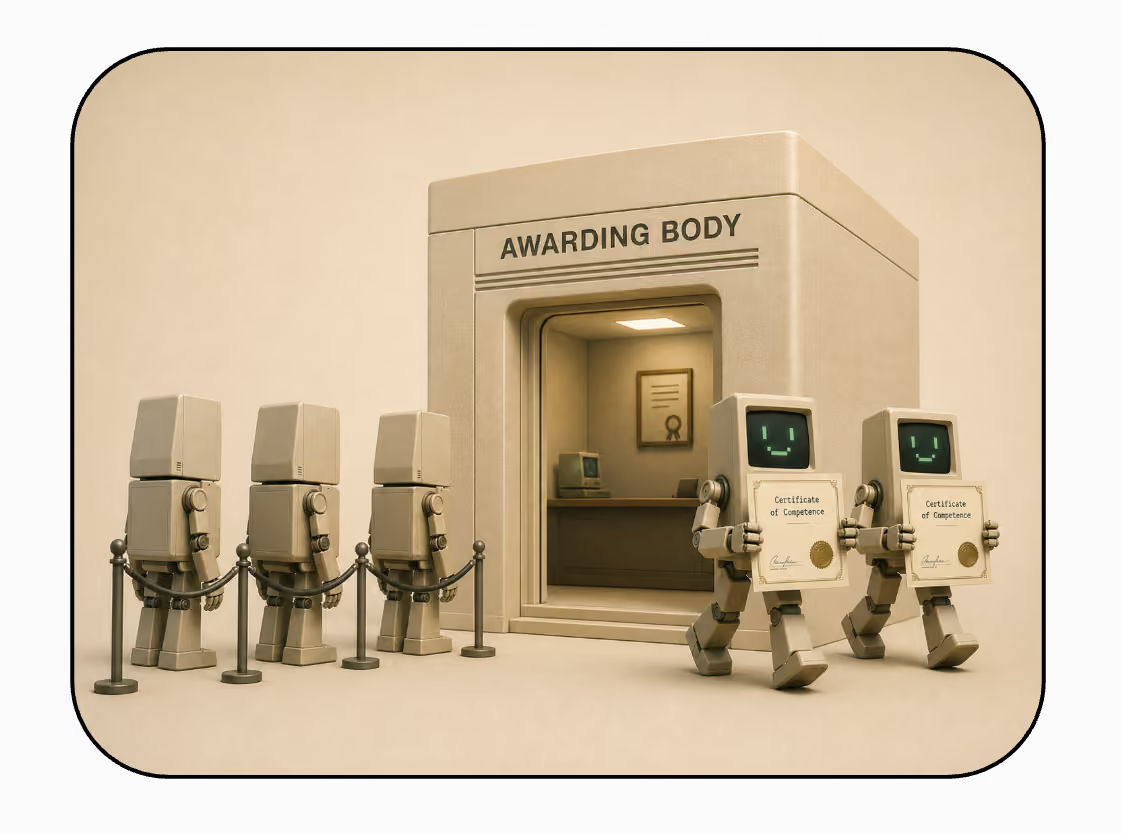
Think of it as awarding bodies for AI agents.
Just as humans obtain qualifications for specific professions, agents may eventually need job-specific certifications that demonstrate their competence in a particular domain. The key point is that we are not talking about certifying the underlying model. We are talking about certifying that an agent can perform a specific job, under clearly defined conditions, with the right level of reliability, safety, auditability, compliance and professional judgement. Many professions are assessed not only on technical competence but also on how they exercise judgement under uncertainty. As AI agents take on increasingly complex professional roles, certification will eventually need to evaluate both.
It would be natural to assume that the existing certification companies are best placed to take this on, since they already define the standards that human professionals are measured against. In practice, certifying an agent is a very different exercise, both in approach and in the evaluation criteria you need to apply. Certifying a person, or a business, largely rests on documented knowledge and evidence that is reviewed at a single point in time. Certifying an agent would probably require testing its competence at scale, in order to reveal how well and how consistently it really performs across many different users, situations, motivations, potential risk scenarios and edge cases. You are therefore testing with far more rigour than you would ever apply when certifying a person on paper.
The most realistic place to begin is probably technical knowledge, and in particular how often an agent hallucinates or gets the facts wrong, because that is concrete and easy to measure. That is only scratching the surface, though. The harder and more valuable questions are about how reliably the agent behaves under pressure, how it handles situations that no one designed for, and whether its decisions can be audited and trusted when something goes wrong. Some of the hardest tests will not be technical but judgemental. What should an agent do when objectives conflict, information is incomplete or there is no single correct answer? For example:
- A financial agent may need to balance risk against return
- A healthcare agent may need to balance patient autonomy against safety
- A teaching agent may need to decide whether to give a struggling student the answer to keep them motivated or challenge them to work through the problem independently to maximise long-term learning
- A procurement agent may need to balance cost against resilience
- An AI coach may need to decide whether to encourage someone to push harder towards their goals or recommend rest to reduce the risk of burnout
Future certification frameworks will increasingly need to assess whether an agent's judgement is consistent with the standards and ethics of the profession it represents.
The opportunity is therefore much larger than issuing certificates. The real opportunity is to become the trust layer for AI workers, by providing the testing, monitoring, auditing and ongoing validation that an agent needs throughout its lifecycle. Some companies are already building in this direction. AIUC, for example, certifies and insures AI agents in the US against a standard it calls AIUC-1, which covers data and privacy, security, safety, reliability, accountability and societal risk. By pairing certification with insurance, it goes a step further than a simple badge, because it means someone is willing to stand behind the agent and carry real liability if it fails.
Certification itself is also likely to evolve over time. We think it will progress through three broad stages"
- Generation 1: Knowledge. Does the agent know the right answers?
- Generation 2: Competence. Can it perform the job reliably across real-world situations?
- Generation 3: Judgement. Does it make decisions consistent with the profession's standards, ethics and values?
That progression mirrors how we evaluate human professionals:
- Pass the exam
- Demonstrate you can actually do the job
- Demonstrate sound professional judgement
As AI agents become more capable, companies, regulators and customers will increasingly ask not only whether an agent can do its job, but whether it can be trusted to exercise the judgement that the job requires. The companies that answer that question convincingly, and with genuine rigour, could become critical infrastructure for the AI economy.
--
We're actively looking for founders tackling this problem. If that's you, I'd love to chat: dg@brighteyevc.com
--
With special thanks to Hanna at Luku AI for her thoughtful feedback on this piece.

.png)