
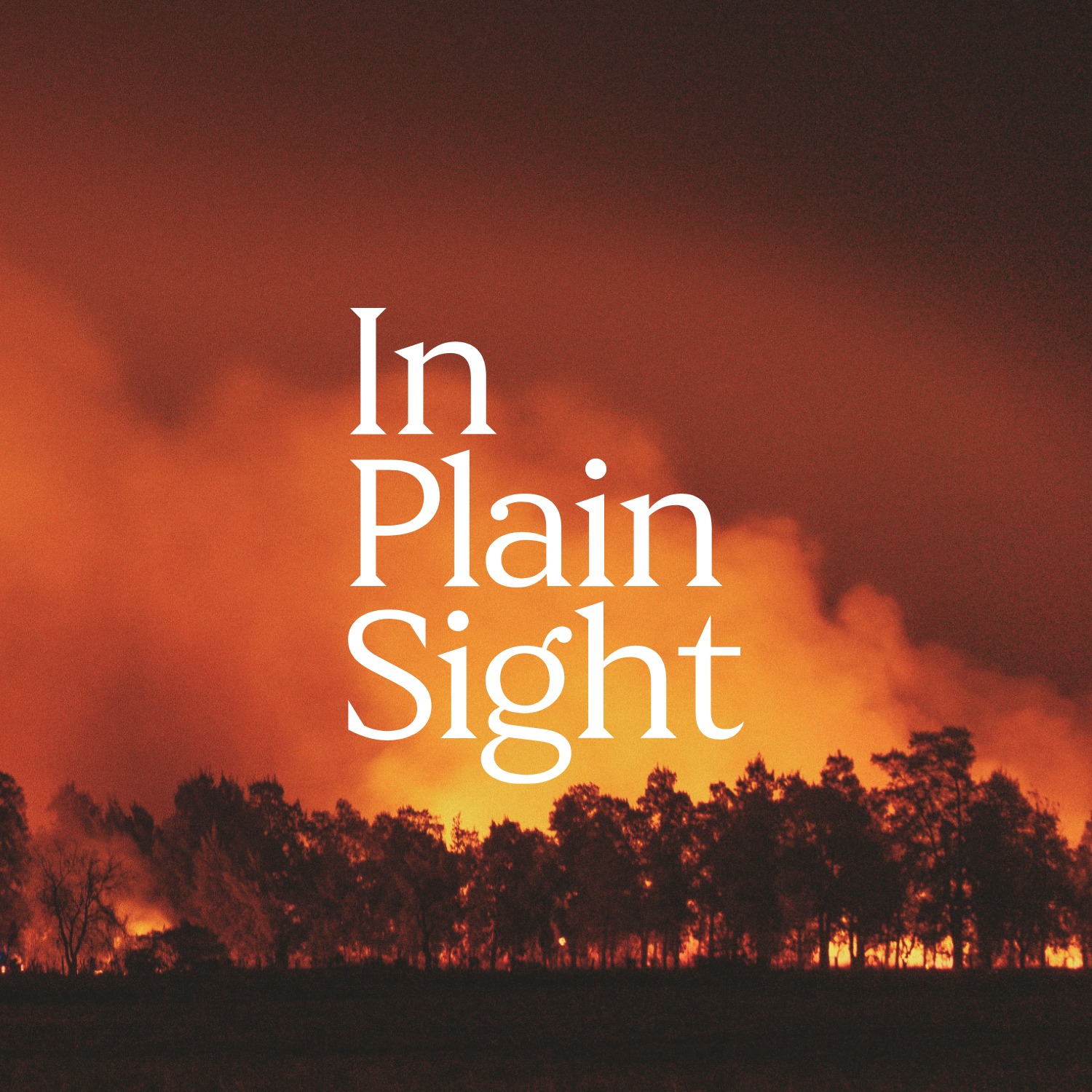
This summer, wildfires have torn through the pine forests around Bordeaux, forcing the largest evacuation France has seen since the Second World War. In Spain, more than 300,000 people were displaced as a fire cloud generated its own thunderstorms over villages between Madrid and Ávila. This isn’t a a one-off; it follows the LA fires of January 2025 and a European wildfire season that has already overtaken 2025's record-breaking year.
We've been here before, albeit in smaller doses, most summers since 2018. What's changed is the visuals of the crisis. This time around, it’s scorched, ash-grey plains reminiscent of the place the hyenas call home in The Lion King (see the final 6-7 seconds of the video in this BBC article). Arguably, this resemblance does more educational work than a textbook chart on gradual warming.
There's a reasonable instinct to worry that showing children burning villages is alarmist, or that it risks tipping into despair rather than action. We'd push back on that a little. Sea level rise is real and existential, but it's slow, distant, and abstract to a fourteen-year-old in Bordeaux. A wildfire forty minutes from their home is none of those things. It is shocking to watch your own homeland catch fire in a way it never used to. That shock, used carefully, is a more honest starting point for climate education than a diagram of the carbon cycle, not because it's more frightening, but because it's more true to what's actually happening now, i.e. it’s not a graphic simulating seaside towns flooding in 2100 due to sea-level rises of Xmm per year…
Ask what European schoolchildren are actually taught about this and the answer depends enormously on where they happen to be growing up. We ran a brief comparative analysis of France, Spain, Germany and Italy's geography curricula and found real differences in how much physical climate content each includes and in whether the emphasis falls on the natural science or the socio-economic consequences. Italy remains the only EU country to have made climate change education compulsory across the curriculum, rather than confined to geography or science lessons. In the UK, it still largely lives in geography and PSHE, at the discretion of the school.
Meanwhile in Finland and Sweden, it is framed as sustainability, which is treated as a value woven through the whole national curriculum from primary school onward, rather than a topic bolted onto one subject. This, at least to us, is the most instructive approach. When climate content sits inside geography alone, it gets taught as facts: causes, effects, some case studies. When it sits inside a value ("direct students towards a sustainable future," as Finland's core curriculum puts it), it gets taught as a disposition. You tend to forget facts over time, but dispositions tend to stay with you. It's also worth noting that this is framed as 'sustainability' rather than climate education. 'Climate education' can accidentally slip into being politicised - whilst 'environmental education' and 'sustainability' feel more neutral...
It's worth dwelling on the Nordics specifically, because they complicate the story in an interesting way. These are, by most measures, the most environmentally conscientious societies in Europe - they have carbon-neutrality pledges, climate baked into the curriculum, a cultural relationship with nature that non-Nordics tend to romanticise. And yet Europe is the fastest-warming continent on Earth, warming at more than double the global average rate since the mid-1990s and the Arctic sits just above that, warming even faster still. Finland has already logged average temperatures 3.4 degrees above pre-industrial levels. Norway, Sweden and Finland have all recorded heatwaves stretching past two weeks in regions whose homes, hospitals and schools were built for cold, not heat…
The mechanism is worth teaching on its own terms: the albedo effect (I’m not showing off, I actually learned about this effect via an article a couple of weeks ago). Snow and ice reflect sunlight; bare ground and open water absorb it. As Arctic ice melts, it exposes darker surface underneath, which absorbs more heat, which melts more ice. This happens to explain why the countries doing the most ‘right’ on paper are still warming the fastest. That's a genuinely useful thing for a fifteen-year-old to understand because it demolishes the comforting idea that virtue offers protection.
Our uncomfortable sense is that awareness and belief in climate change appear to have only a modest influence on whether people actually behave sustainably and the gap between what students know and what they do is apparent inside schools as much as outside them. In the 2018 PISA study, German students ranked worst of all countries surveyed on readiness for sustainable action, with Italian and French students close behind - despite Germany, Italy and France all having climate content in their national curricula. Spanish students scored below the OECD average on readiness too, even while scoring above average on awareness.
That's the focus of this piece: teaching the facts of climate change is not the same project as cultivating an instinct to act on them. Most European curricula have optimised for the former. Almost none have found a reliable way to do the latter. Maybe the same behavioural science points we have been discussing in other Sidekick pieces should be part of this discussion…?
So, what would an apolitical version of this look like, because it should exist and mostly doesn't? We think the confusion comes from three genuinely different things being combined into one subject or concept called "climate education," when they don't necessarily belong together and don’t necessarily carry the same objective.
The first is civic responsibility: a basic respect for the place you live, taught in the same way you’re taught to not leave litter on a beach or not waste food. This has never been political, in the sense that it has never required agreeing on carbon taxes or drilling licences; it just requires agreeing that damaging your own habitat is something we can agree we don’t want to happen. Because it isn't political, it's also the one piece that can be woven into everything: it belongs in how a school runs its canteen and provides teaching materials as much as in what it teaches.
The second is science: the mechanics of why this is happening and how it will keep evolving - for example, the albedo effect, atmospheric circulation, why the Arctic is warming three times faster than the equator. This is squarely geography and physics territory and it should stay there, taught with the same rigour and the same tolerance for uncertainty as any other scientific subject. It answers "why," not "what should we do about it."
The third is policy: whether to subsidise heat pumps, licence North Sea gas fields, build data centres, or tax frequent flying. This is where reasonable people genuinely disagree, where trade-offs are real, and where a classroom purporting neutrality while pushing a specific answer does more harm than good. This layer belongs to policymakers and the democratic process, rather than a PSHE lesson but it still represents an interesting subject of debate for young people (PSHE is, effectively, the UK’s sprawling name that covers all sorts, including, I suppose, ‘civic education’).
In our view, the Nordics, again, are the model worth pointing to because their curricula keep these layers separate on purpose. Sustainability appears as an ambient value across every subject (the civic layer), climate mechanics get taught rigorously inside science and geography (the scientific layer), and the genuinely contested policy choices are left to policy.
The end point doesn’t need to be a generation of activists or a generation of sceptics but rather a generation of people who make reasonably mindful decisions by default, the way most of us now recycle without being told to because it became instinctive. Understanding the "why" in geography class makes that instinct more durable but it’s not a pre-requisite.
The "respect" framing needs additional commentary. I think few people believe global air travel is going to meaningfully shrink and treating "fly less" as the primary ask of climate education sets students up to fail or to disengage. The more honest lesson is that our appetite for flying, cooling our homes, and moving freely isn't likely to go away, so there is work to be done to build the version of those things that doesn't heat the planet.
This is where environmental entrepreneurship, in our view, could earn a place in the curriculum. It’s an incredibly exciting area of innovation, most of which sits within hardware and development of new materials but some of which fits within our learning and work thesis (see Intaller.com, La Solive, Wikifarmer, Agroleague…). UK-based OXCCU has built a single-step process that combines captured CO₂ with green hydrogen into jet-fuel-range hydrocarbons and raised a £20.75 million Series B to scale it. LanzaJet's Georgia plant is already producing ASTM-certified aviation fuel from waste ethanol at commercial scale. Norway's Norsk e-Fuel is manufacturing synthetic jet fuel from captured CO₂ and renewable power. ZeroAvia and H2FLY are both flying hydrogen-electric aircraft. None of these companies are asking anyone to fly less - if anything, this isn’t in their long-term interests! They're making the flying we're already going to do less catastrophic. This is the entrepreneurial answer to a problem that pure behaviour change can't solve on its own.
We'd be doing this argument a disservice if we didn't pressure-test it. Framing climate change as an entrepreneurial opportunity risks becoming a comfort blanket, a way of implying the market will simply solve this if we wait for the right founder, which lets both individuals and governments off the hook for the near-term choices that actually impact emissions curves. And "apolitical" education has limits: at some point, decisions about drilling licences, subsidies and land use are unavoidably political, and pretending otherwise can tip into a kind of false neutrality that avoids the hard conversations altogether.
The UK's North Sea is a good example of exactly that tension. It still contributes an estimated £25 billion a year to the UK economy and supports over 100,000 jobs, even as production declines and the government tries to manage a transition toward offshore wind, carbon capture and hydrogen without stranding the communities built around oil and gas. Reasonable people disagree about the pace of that transition and a curriculum should not pretend the answer is obvious. What it can do is teach the trade-off honestly: economic security and environmental security are not opposites, but they don't have the same timeline and cost-of-living pressure will keep winning short-term arguments against climate priorities unless the clean alternative is also the cheaper one (which is understandable - it’s tough to convince someone to stomach more expensive energy choices if this means they have to forgo cooking a meal or taking a shower). The right choice needs to be the easy choice.
Pull the argument together and it actually sounds fairly simple. Civic responsibility toward the environment isn't, has never been and shouldn't become a political position - note 'environment' rather than climate education. It's a habit and the average person's job is just to build it, the way they'd build a habit of not littering. Geography and science are where the interesting, unresolved "why" lives: why the Nordics are warming fastest despite doing the most, why fire behaves the way it does in a drought, how the climate system is actually evolving. And policy - North Sea licensing, subsidy design, the pace of the transition - is the layer that's legitimately contested, and belongs to policymakers. All parts can make a difference and all parts are interdependent.
Confusing these three is how climate education has ended up simultaneously under-taught and over-politicised: too thin on the habit, too shallow on the mechanism and too tangled up in the arguments that should be addressed by policymakers acting on our behalf. Our thesis on climate education is that if you separate them, each part gets stronger. The habit becomes uncontroversial enough to teach everywhere. The science gets to be genuinely rigorous rather than confused for a message. And the policy debate gets fought where it belongs, by experts, in public, with the trade-offs stated honestly.
For those building curricula: the Nordic model is the one we consider worth studying closely. Weave the civic habit through every subject rather than isolating it in one.
For founders: the opportunity sitting underneath all of this is the unglamorous, infrastructural kind - decarbonising the things people have no intention of giving up, from flight to cooling to shipping. The learning and work layer sits in making it happen. We're always glad to talk to people building in this important space.

.png)